Article 2: Spare the Rod, Spoil the Cop

“When it comes to institutional or systemic racism, it’s there and it stays there because someone, somewhere, is benefiting from it.” -Prince Harry, The Duke of Sussex, per the Queen’s Common Wealth Trust
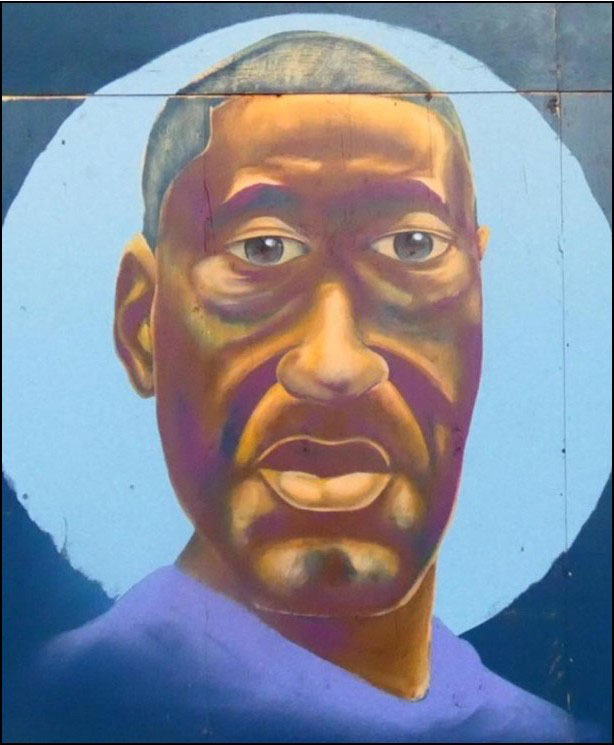
A mural featuring George Floyd temporally displayed in downtown San Jose, California.

Ten weeks ago, one of Breonna Taylor’s killers, Sergeant Jonathan Mattingly of the Louisville Metro Police Department, sat across from Michael Strahan on Good Morning America. The fraught and feeble—yet morally bankrupt cop suffering from little more than privilege managed to tell a murder story full of inconsistencies, befoul George Floyd’s memory, and when prompted—issued hope that Taylor’s mother will find a way to bare the consequence Taylor ultimately brought upon herself. In 10 minutes, despite being party to a sloppy and negligent police raid that ended the life of one and terrorized another, Mattingly managed to depict himself as the damsel.

Race had never been a factor to Mattingly who lives in a world different than you and me—where racial profiling is criminal profiling, murder isn’t really murder, rape is just cop sex, and illegal search warrants aren’t a desecration of one’s constitutional rights.

Go back seven months to the Friday afternoon of May 29th, where a scene—first seeded on the 101 freeway–soon settled on the normally uneventful grounds of the San Jose city hall, in middle California. A war zone pitting the San Jose Police METRO (SWAT) unit against incensed protestors. Profane shouts and water bottles crossed paths—midair—with amplified police commands and airborne cans of tear gas. Unlike our social justice neighbors to the north (Berkeley, Oakland, and San Francisco) this scene was uncommon. The burning of the lachrymator as it filled the air—then our eyes and lungs—of protestors, on-lookers and journalist, became as seditious as the modern day lynchings of our time. 2020 has become yet another milestone for racial inequality where the streets again speak for themselves—the same streets inspiring a 17-year-old white Trump supporter and cop enthusiast to pick a Milwaukee suburb as an ideal hunting ground.  Those aghast by the destruction, looting, and violence would be wise to consider: Would the level of anger & violence be so high if the bar for police conduct weren’t so low?

Earlier this year, a light—however dim, had been shone on the police. Stripped bare—the so called “blue lives” were paraded about the country’s town square while the Black Lives Matter movement trailed it with a ringing bell, shouting SHAME! SHAME! At least for a time.

The CATALYST: the peremptory homicide of George Perry Floyd Jr., a 46-year-old black man—strangled to death as four Minneapolis police officers circled him like a pack of wolves mid-lunch. One threatening anyone with the audacity to intervene…and the alpha male on his neck. Then came the shooting of Kenosha, Milwaukee’s Jacob Blake on August 23rd–by an officer with the fear capacity of 6-year-old girl (and a disregard for the concept of de-escalation) only furthered the disillusionment of the police race relations. Both scenes were a true testament to the founding function of our police. It brings us back to the days when officers blended in with smiling white onlookers while black men and women were captured and hung from trees like ornaments. The uniform worn by their attackers–makes them the byproduct of this lands racial epidemia, perhaps Floyd and Blake are the Strange Fruit Billie Holiday once sung of too.

Those unable to grasp the horrors of being black in the Jim Crow era, are insensible and unbothered by the residuum of it today. The decedents of the 1700’s slave patrols—those tasked with capturing, punishing, and re-implementing oppression on to those whom they felt lacked recognizable humanity—singled out, hunted, restrained, therefore robbing their detainees of control over their physical safety. The reintroduction to the origins of policing times itself congruently with our president’s introduction into the philosophy of 1960’s segregationist Governor George C. Wallace, this mystery era when America was supposedly at its greatest.

As a San Jose State University journalism student researching policing practices, I’ve seen the salivating eyes of officers relishing inconspicuous moments where they know their conduct will either go unnoticed or disbelieved. I too have been harassed and dehumanized. I too have felt the fear they impose, particularly when being black.

But before I’d conflated the race history of law enforcement with today, I find it interesting to note that my earliest police harassment often drew me to the convictions of Mary Turner—a young black woman who resided in Brooks County, Georgia in 1918–found herself decrying the lawlessness of whites and authority in her rural town when a tirade of lynchings had occurred in the search for a white farmer’s murderer. I understood her need to follow common sense over conformity despite knowing her voice would mean little more than a death sentence. One day after her husband had been one of 16 men falsely lynched for the crime, Turner was kidnapped and tied by her ankles to a tree to be set ablaze. A member of that mob took a knife to her pregnant stomach, cutting an 8-month fetus from her and stomping it to death when it fell to the ground before barraging her body with bullets. She was left hung from the tree to send a message.

Interacting with police forced me to explore my relationship with fear. Director Steve McQueen–a black brit, told the Hollywood Reporter in 2018 something of a mantra: “Sometimes you are constrained by fear. I always try to make fear my friend, because I know fears’ coming. I say ‘hey fear, how you doin’—therefore you just bring it on.”  Perhaps a sit down with tea may be the first step to confronting these blue boogeymen in dark corners.

Floyd’s murder had sparked a chemical response from police institutions across state lines—initiating what I like to call Operation Gaslight. First, a well calculated move to temporally halt a retort of BLUE LIVES MATTER by cleverly utilizing the public spotlight. Rebuking the abhorrent conduct of officers Derek Chauvin and his three partners, officers Tou Thao, J. Alexander Kueng, and Thomas Lane, debulking them like a cancer from the institution. Some falling to a knee as they claim to be the 99%, the words BLACK Lives Matter pained through gritting teeth—while patiently waiting for Floyd’s death and subsequently inarguable anger to dissipate like a morning fog. But ingrained habits die hard.


Spare the Rod, Spoil the Cop (Part 2/4)

In June, New York Police Benevolent Association president, Mike O’Meara, stood before the press against a back drop of his fellow officers—and in his best rendition of the The Elephant Man’s ‘I am not an animal’ speechquerulously denounced the notion he and his colleagues should be seen as boogeymen to be feared. Footage began to emerge of faceless officers in riot gear assaulting press, peaceful protestors and the violent agitators shadowing them. Right wing pundits conveniently conflated the victims of black-on-black crime with police shootings, making wild deplorables the common denominator. And like sweet gas lighting preserves, officers were able to eclipse reality through voicing fear of violent retributions against them for “doing their jobs”—while a McIntosh Sheriff’s deputy broke down into the lens of her iPhone, debating the fate of her egg McMuffin in this social climate. A viral video better suited—perhaps, for the officers who actively soil her badge.

San Jose’s own chief Eddie Garcia had been confronted with an incident on May 29th in which a goading officer shot a life altering rubber bullet at peaceful protestor, inflicting internal damage. Garcia responded with disappointment but was quick to praise officer Jared Yuen as a “good kid”. I wondered if Garcia’s praise would have been so solicitous had one of his sons been at the receiving end of that rubber bullet, possibly rendering him unable to bare a grandchild. Garcia later apologized for the comment after backlash.

Perhaps it’s the inability to draw a line bolder and more defined than the established blue one—lest it not be the fault of police—but of those who empower and enable them to run unleashed. San Jose’s Mayor, Sam Liccardo, has drowned out his own proposals for procedural change of police with an unmerited and highly deceptive comment proclaiming most SJPD officers to be good. The former district attorney has clearly never had a frank chat with our city’s two former Police Auditors, LaDoris Cordell and Aaron Zisser—two individuals who have reviewed the most heinous of (and mostly unpunished) accusations against officers, including the supporting evidence. 

What I see in Liccardo can also be seen in those holding decisive position on police power, with common resistance to rock a boat of policing change into uncharted territory—the possibility of dire chaos. It will be the diligently naïve and intransigent public whose hesitation—or toe dipping—into a most perfect policing system—that will only encourage a more unethical chaos, breeding toxic cops. As a country, we are slow to needed progression. The conclusion of slavery (the very workforce this country was built on) wavered and contenged on the colonial fears of the disenfranchisement and financial upheaval it would cause to the lives of slave owners. Lincoln took a begrudged leap of common sense (among other things) towards progress and reform—and while results of that decision have not quite finalized, it has progressively materialized a better and more righteous union.

Despite the condemnation and distancing of ranking officers scrambling for damage control, they stop short of relinquishing the long-standing impunity officers enjoy. Perhaps it wasn’t the death of Floyd prompting a defiance of themselves, but the reaction his death garnered. Most of the officers I’ve spoken with over the past ten years would relate to Chauvin and Co.—and the decisive conduct inculcated with their profession’s high school-like peer pressure. They understand why not one officer intervened, but critical of Officer Thoa’s inability to intimidate on-lookers out of their first amendment right to spy. Why wasn’t one of the officers holding a digital blocker to prevent filming? And officer Chauvin—who killed in the light of day what a simple police flashlight could have blocked from cameras in the black of night.

By fall, it seemed the wave of change was no wave at all. Proponents of police and—more discretely—white supremacy, have, if anything, grown emboldened by the images of Floyd’s murder. Republican senators such as Josh Hawley (R-MO) and Tom Cotton (R-AR) walked away from the event with the opinion that police needed more power through legislation.

The Minneapolis Police union vowed to see the reinstatement of Floyd’s 3 remaining killers—before they too had been indicted alongside Chauvin.  Three Wilmington, North Carolina officers were fired after a recording captured the use of racist language and their desire for a race war. Three Aurora, Colorado officers photographed themselves mocking the murder of Elijah McClain at the sight of his death–so reminiscent of the days when hung black men were photographed and sold on post cards in the Deep South. And in a tribute to the nefarious lineage of racism running through the bloodline of policing—the New York City POA’s unsettling endorsement of notorious birther, Donald J. Trump.

Social media sites belonging to the family and friends of local officers went either silent or flagrantly indignant to the vitriolic public interrogations their loved ones faced.  Ignorance runs rampant within those close to officers, blind—and at times injudicious because the blood of the black and the disenfranchised stains different on a police uniform. Is it only in the criminality of a cop when his purpose is maintained?

It takes incredible audacity to wear membership to the murders of Botham Jean, Eric Garner, Michael Brown, Stephon Clark, Philando Castillo and Alton Sterling—or to the negligent handling of Freddie Gray, Sandra Bland, and Akai Gurley—only to then claim officers are the truly misunderstood victims of these crimes. A Modus Operandi magic trick eliciting sympathy from the public that they are far more oppressed than those they silence—through no amount of rationality but plenty of entitlement.

Lynching victim Will Brown in life, and in death, year 1919. (source nebraskastudies.org)

During her time, it was the likes of Jesse Washington (a mentally ill youth), Will Brown, Marie Thompson, Mark Charles Parker—and the 3,446 dead by 1968 for their melanin deformity—who compelled journalist Ida B. Wells to state in 1909: “This is the never-varying answer of lynchers and their apologist. All know that it is untrue. The cowardly lynchers revels in murder, then seeks to shield himself from public execration by claiming devotion to woman. But truth is mighty and the lynching record discloses the hypocrisy of the lyncher as well as his crime.” Simply replace “devotion to woman” with more modern claims such as “I thought he had a gun”, same shit—different century.

If only those typified within the words of Well’s had existed at a better time and place—a decade later, I say the same of the black and brown today.

While researching this piece I recalled the murder of Daniel Shaver, a white plumber from Granbury, Texas who the nation watched—through the lens of a body camera—beg for his life before being mercilessly obliterated by a Mesa, Texas cop in a hotel hallway. These are the things nightmares are made of—the parental fear President Obama (a black man) and Mayor Bill DeBlasio (the father of a black man) express out loud against criticism. These executions are the quiet part being spoken out loud—lauding distortedly depths of depravity as acts of bravery by sworn men.  Murder isn’t murder. Privilege isn’t bad. Injustice is justice. We are to revere officers as human beings yet we are coached to survive a police encounter by way of our local bear attack survival guide.

How many officers, standing in the wings gauge their invincibility against the biblical ‘shall nots’? Officer Philip Brailsford was acquitted of Shaver’s murder in 2017 and reinstated to his department. He has reportedly since retired.

The accurate intent of law enforcement is to be the resolute factor of a situation, not the incendiary of it. One is not supposed to determine the decisions of a cop and therefore should not be blamed for the escalation of their behavior. And until this is realized, one shall not be shamed for their fear of those who claim the image of hero but the disposition of monster. And a department’s bill of guilt shall not be paid by the tax paying public—but to be made clear, those irrational enough to think that taking a police officer’s life is an appropriate reply to police brutality will find themselves working against any logical, mature solution!

Bad cops make for the best criminal justice instructors, because when listened to with a sensible ear–they tell the truth. An officer’s firearm training–I once presumed–at best called for the temporary incapacitation of a life—which to that, in 2011, a senior San Jose police officer shook his head. “You wanna take out the computer”, he said—taping a finger to his temple.